1. Definitions
Definition 1.1 (Group)
A group is a set $G$ with an composition $\cdot : G\times G\rightarrow G$, where $(G, \cdot)$ satisfies:
Associativity: $\forall a,b \in G, (a\cdot b)\cdot c = a \cdot(b \cdot c)$
Identity element: There exist an element $e \in G$, such that $\forall a\in G, ea = ae = a.$
Inverse element: $\forall a \in G$, there exists an element $a^{-1}\in G$, s.t. $aa^{-1} = a^{-1}a= e$.
We usually denote $(G, \cdot)$ simply as $G$. And the three condition we usually call group axioms.
The identity and inverse is automatically unique by definition.
If the composition of a group is commutative, we call it an Abelian group:
Definition 1.2(Abelian Group) An abelian group $(G, +)$ is a group which satisfy commutativity of addition:$$\forall a,b\in G, a+b = b+a$$ Its identity is usually denoted as $0$ and the inverse of $a$ is denoted as $-a$.
For example, $\mathbb{Z}^+$: Integers with addition, is a group and an Abelian group.
Definition 1.3. The order of an element $g$ of $G$ is defined as an integer $n$, such that $g^n = 1$.
Note that some elements of $G$ may have infinite order, that is, $\forall n, g^n \not = 1$.
2. Subgroups
Definition 2.2 (Subgroup)
A subset $H$ of a group $G$ is a subgroup of $G$ which has following properties:
Closure: $\forall a, b \in H, ab\in H$.
Identity: $e_G \in H$
Inverse: $\forall a, a^{-1} \in H$
$a\mathbb{Z} + b\mathbb{Z}$ is a subgroup of $\mathbb{Z}^+$, and this subgroup has a generator $d$, which is a positive integer s.t. $a\mathbb{Z} + b\mathbb{Z} = d\mathbb{Z}$. Specifically, $d = gcd(a,b).$
Definition 2.3 (Normal Subgroup) A subgroup $N$ of $G$ is called normal subgroup, if $$\forall a\in N, b\in G, bab^{-1} \in N,$$ $bab^{-1}$ is called a conjugate of $a$.
3. Homomorphisms Between Groups
Defintion 3.1 Let $G, G’$ be groups, a homomorphism $\phi: G\rightarrow G’$ is any map satisfying the rule: $$\phi(ab) = \phi(a)\phi(b),\forall a,b\in G$$
That is, homomorphisms preserve group multiplications.
Propersition 3.2 $$\phi(1_G) = \phi(1 _{G’})$$ $$\phi(a^{-1}) = \phi(a)^{-1}, \forall a\in G$$
Propersition 3.3
The kernal of a homomorphism $\phi: G\rightarrow G’$, which is defined as $\ker \phi = \{a \in G:\phi(a) = 1_{G’}\}$ is a normal subgroup of $G$.
Proof. $\phi(bab^{-1}) = \phi(b)\phi(a)\phi(b^{-1}) = 1 _{G’}$.
Definition 3.4 If a homomorphism $\phi: G\rightarrow G’$ is called a isomorphism if it is bijective and $\phi^{-1}$ is a homomorphism from $G’$ to $G$. $G$ and $G’$ are isomorphic.
Propersition 3.5 A homomorphism $\phi:G \rightarrow G’$ is injective if and only if its kernel is trivial.
4. Cosets and Quotient Groups.
Definition 4.1. Let $G$ be a group and $H$ be a subgroup of $G$. For any $a\in G$, $aH = \{ah|h\in H\}$ is defined as a left coset for $H$ of $G$.
Now we define a equivalent relation: $ a\equiv b$ if and only if $\exists h\in H,\ s.t.\ a = bh$. Then we can see that $aH = bH$, since $ab^{-1} \in H$. This means that all elements in one coset belongs to the same equivalent class.
This equivalent relation gives a partition to group $G$. And each part is a coset. So we have the following proposition:
Proposition 4.2. Cosets for $H$ of $G$ partition $G$.
The number of cosets for $H$ is called the index of $H$ in $G$, which is denoted as $[G:H]$. Then we can easily see:
Proposition 4.3. $|G| = |H|[G:H]$
Another useful proposition is:
Corollory 4.4. If $G$ is a finite group, then for every subgroup $H$, $|H|$ is a factor of $|G|$. Especially, the order of each element is a factor of $|G|$.
We know that $\ker\phi$ is a subgroup of $G$, where $\phi: G\rightarrow G’$. If $a\ker\phi = b \ker\phi$, then $a^{-1}b\in \ker\phi$, which means $\phi(a)=\phi(b).$ So we have the following proposition:
Proposition 4.5. $[G:\ker \phi] = |\text{im } \phi|, |G| = |\ker \phi|\cdot|\text{im }\phi|$
Now we focus on normal subgroups. Normal subgroups has a very good property:
Proposition 4.6. If $N$ is a normal group of $G$, then $(aN)(bN) = abN$.
Here $AB := \{ab|a\in A, b\in B\}$.
Proof. Since $aN = Na$, $(aN)(bN) = abNN = abN$.
This property allows us to define multiplication of two cosets. A question is whether all cosets form a group? The following theorem answers this question:
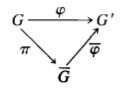
Theorem 4.7. If $N$ is a normal group of $G$, then $\bar{G} = G/N = \{aN| a\in G\}$ forms a group. $\pi: G\rightarrow \bar{G}$ defined by $\pi(a) = aN$ is a homomorphism. And $\ker \pi = N$.
This group is called a quotient group.
For arbitrary surjective homomorphisms, we have the following property:
Theorem 4.8 (First Isomorphism Theorem). Let $\phi: G\rightarrow G’$ is a surjective homomorphism. Let $N = \ker \phi$. We define $\bar{\phi}: aN \rightarrow \phi(a)$. Then $\bar{\phi}$ is a isomorphism from $G/N$ to $G’$.
A generalization of this theorem is as follows:
Proposition 4.9. Let $\phi: G\rightarrow G’$ be a homomorphism and $N$ is a normal subgroup of $G$ contained in $\ker \phi$. Then there is a unique homomorphism $\bar{\phi}$ from $G/N$ to $G’$ such that $\phi = \bar{\phi} \circ \pi$, where $\pi$ is the canonical map from $G$ to $G/N$. And $\bar{\phi}$ is defined as $\bar{\phi}(\bar{a}) = \phi(a)$.